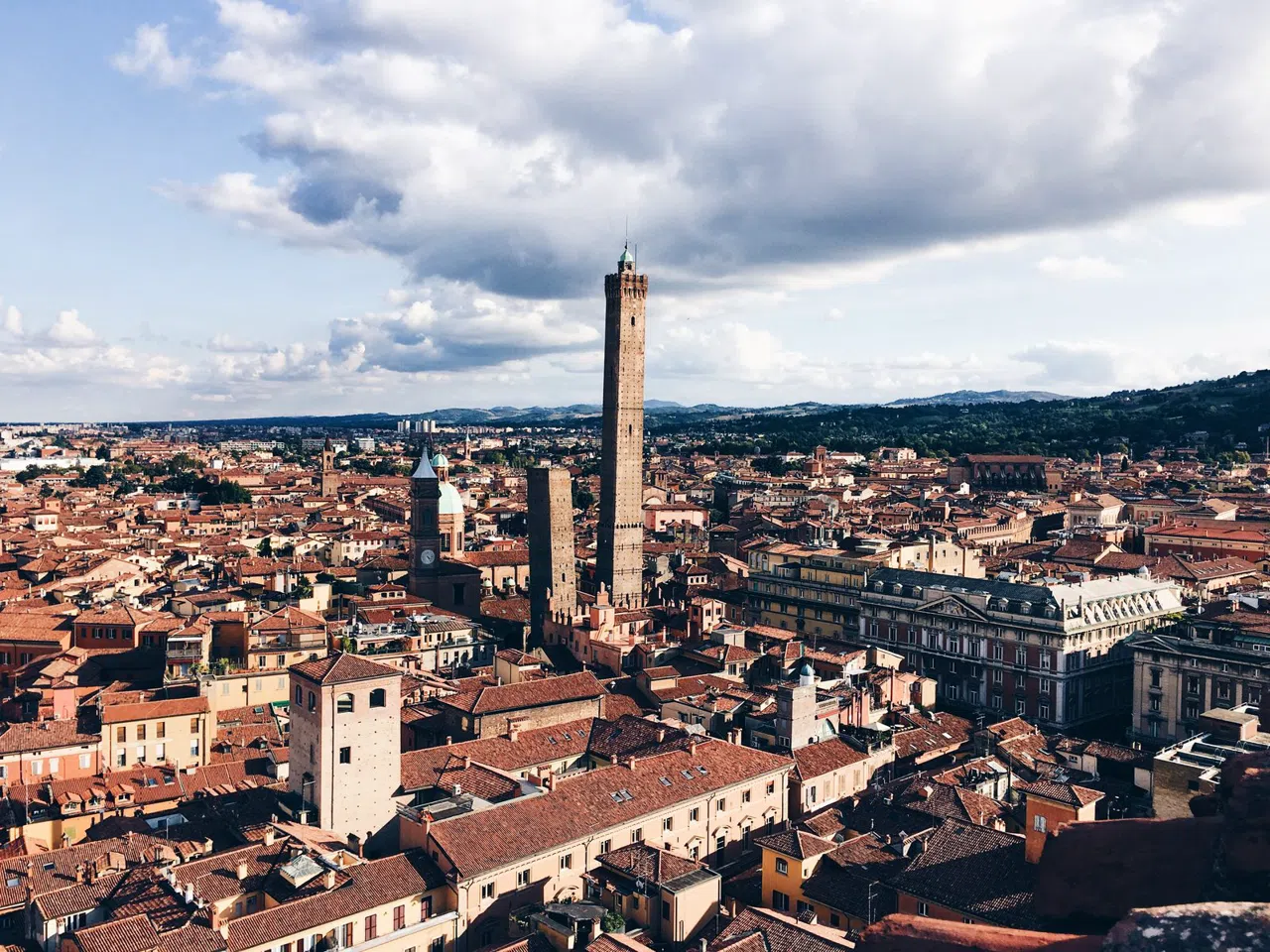

Nine hundred years ago Bologna's skyline held as many as two hundred stone towers, private skyscrapers run up by rival banking and merchant families who had exhausted every other way of outdoing each other. Two survive at the crossroads that still carries their name, leaning at odds with each other over a piazza that has not changed its footprint since the twelfth century. The other hundred and ninety-odd came down, burned, or were quietly dismantled once the point had been made. What's left of that instinct now runs through guided climbs, timed museum visits, and one very good bar built inside a fourteenth-century watchtower.
The two towers that gave Bologna its name
Le Due Torri (Torre degli Asinelli and Torre Garisenda) stand where the medieval Via Emilia forked into the roads for Florence and Venice, and the choice of site was never accidental: whoever controlled that junction controlled the tolls. Asinelli rises 97.2 metres, one of the tallest surviving medieval towers in the world, and leans about a metre and a quarter off true, enough to be visible from the base if you stand square to it. Garisenda, its shorter neighbour at just under 48 metres, leans nearly three times as far, a tilt so alarming that Dante had Antaeus stoop over the Inferno's pit "like the Garisenda, seen at the base of its incline, when a cloud passes over and it seems to lean the more." That line has stood as a passable engineering assessment for seven centuries.
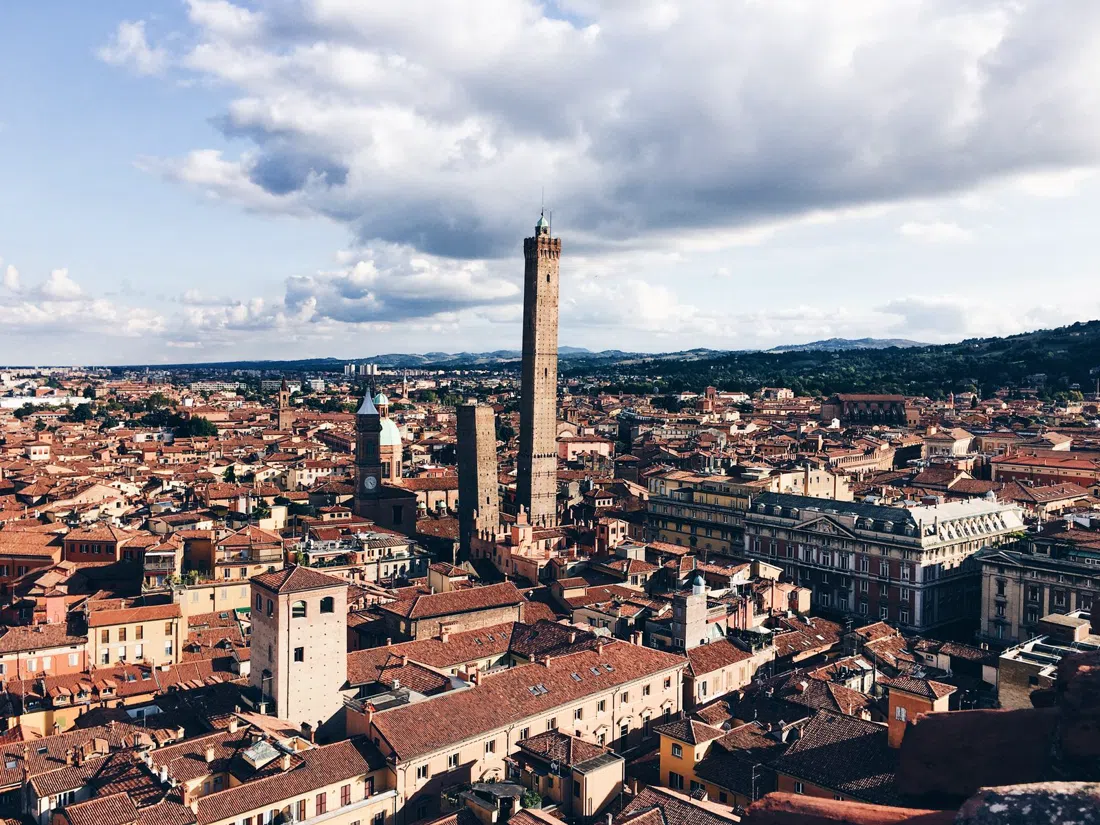
It's still one, unfortunately. In October 2023, structural sensors flagged accelerating deterioration in Garisenda's foundation, and both towers were closed to climbing. Asinelli's staircase had nothing to do with the fault, but the two share a base area, and the piazza itself needed clearing for scaffolding. A roughly €19 million Pisa-style stabilisation project is underway, tying the base with steel and monitoring the lean in real time; nobody in the comune will commit to a reopening date, and some estimates run to 2028. The piazza around them is fully open, handles crowds and tour groups without difficulty, and remains free to view. This is still where a vertical history of Bologna has to start; you simply do it from ground level, craning upward like the medieval visitors who first found this an unnerving way to arrive in a city.
The tower you can still climb
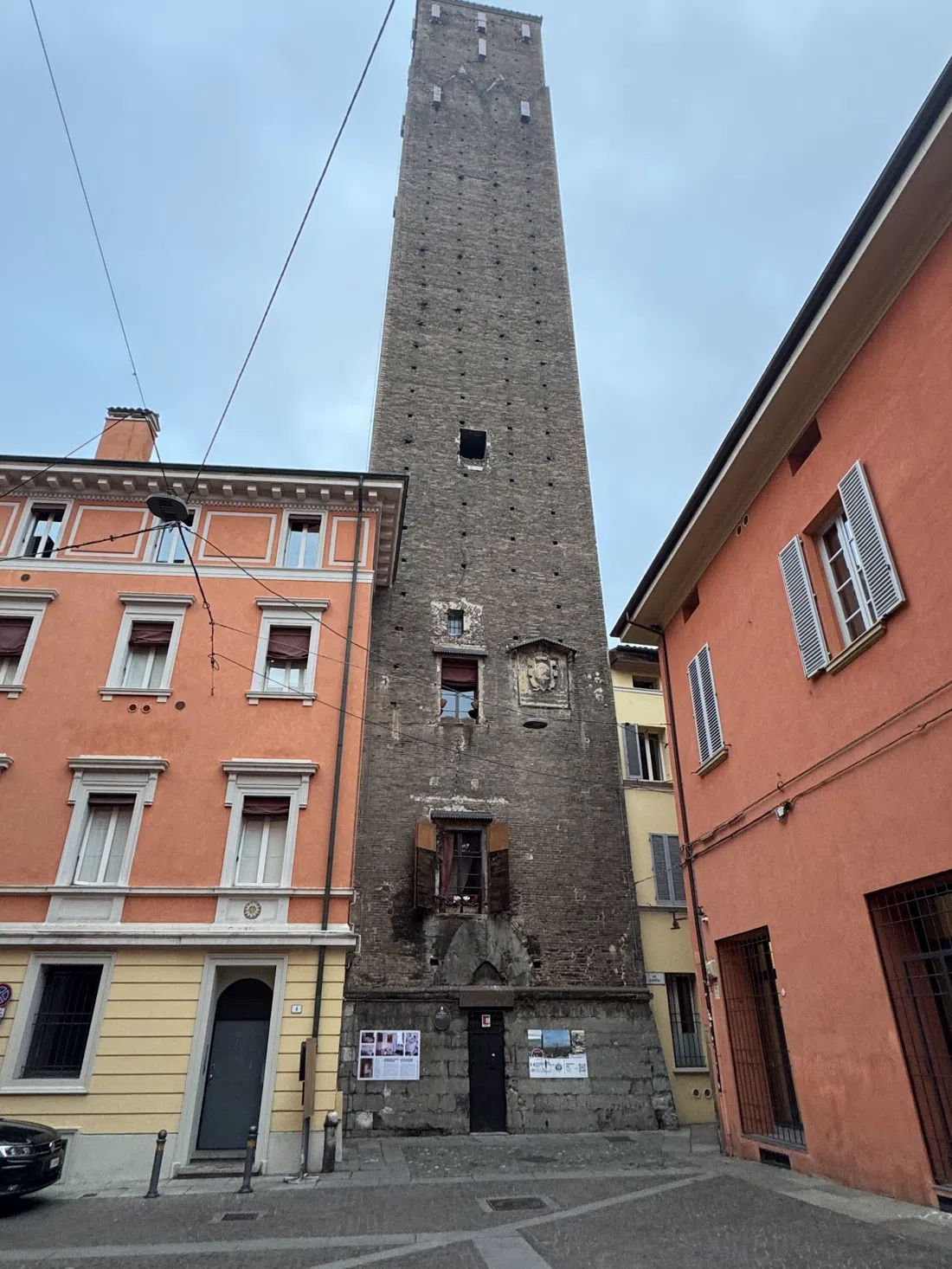
For an actual climb, the city's medieval towers have one honest survivor: Torre Prendiparte, a fifteen-minute walk east of Le Due Torri in the quiet lanes off Via Sant'Alò. Built around 1200 and standing 59.5 metres, it's one of the few private towers to have kept its full height and its original stone stair, and it runs small, timed guided tours. Book ahead: groups are kept deliberately small, and tickets run €6 to €10. The reward at the top is a genuine 360-degree panorama over the two towers you can no longer climb, close enough that the closure stops being an abstraction. Prendiparte does something no other tower in the city attempts: it also operates as an exclusive overnight stay, one party at a time, from around €800 a night, the whole medieval structure handed over with a telescope and a bottle of wine. It's a strange, memorable way to sleep above Bologna, and entirely unsuited to a family group of eight. Check the booking terms before assuming it flexes to your numbers.
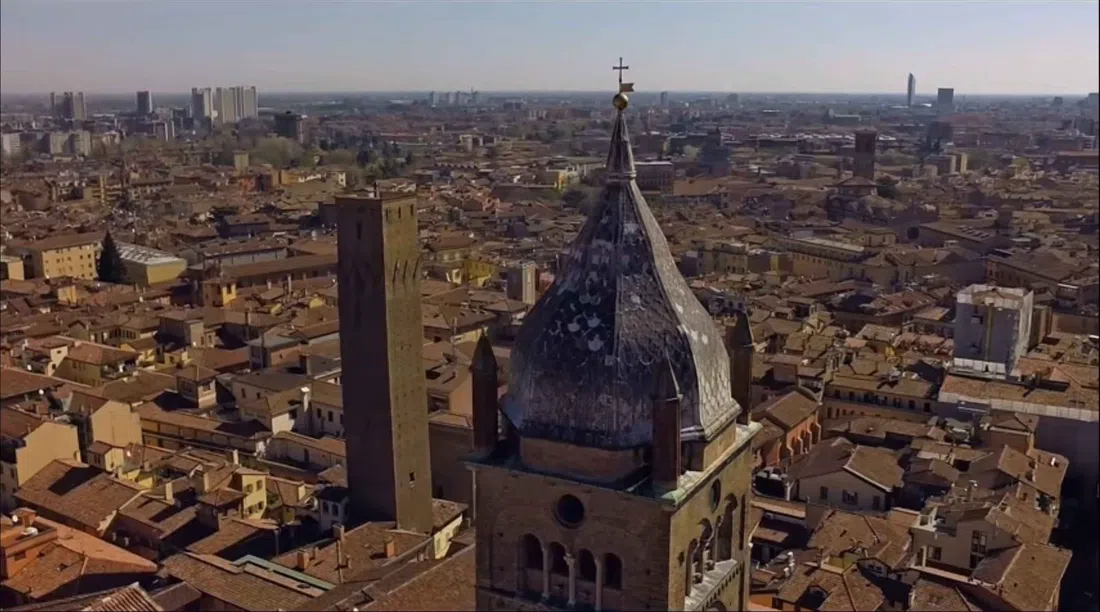
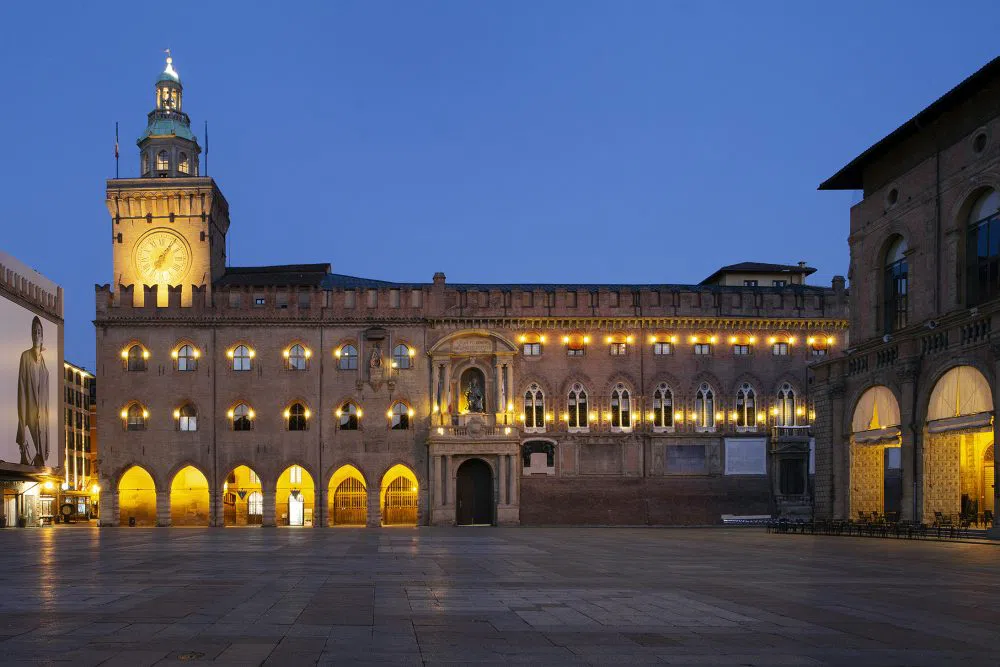
The other tower still open to the public sits in plain civic daylight: the Torre dell'Orologio, the clock tower rising over Palazzo d'Accursio on Piazza Maggiore. It runs timed-entry visits, with a reduced rate for groups, and the climb is genuinely narrow. The summit staircase requires a signed waiver, and children under eight aren't permitted on it at all, which is worth knowing before you queue with a pushchair. Full price is €10, the group-reduced rate €7. What you get for it is the terrace the guidebooks used to promise from San Petronio before that one closed for good: an open, working panorama straight down onto the piazza and out to Le Due Torri on the skyline, the only place left in the historic centre where you can stand above the towers rather than beneath them.
Eight centuries read indoors
On a wet day, or simply for the version of this history that comes with expert framing rather than a neck ache, the Museo della Storia di Bologna at Palazzo Pepoli (the Genus Bononiae complex, directly across from Le Due Torri) earns its ticket. It's an unusually good city-history museum, climate-controlled, built quite literally around a "tower of time" motif that traces how a city of feuding tower-owning families became the Bologna of guilds, university, and porticoes. Adult entry runs roughly €10 to €15, group rates are available, and it handles school groups and coach parties as a matter of routine. That's useful if the piazza outside is doing that thing where every tour group in the city has arrived at once.
A ten-minute walk south-west, past the market stalls, the Archiginnasio Palace and Anatomical Theatre widens the claim past towers altogether. This was the seat of Europe's oldest university before it moved to its current site, and the building itself (arcaded courtyard, walls layered with centuries of students' coats of arms, a wood-panelled anatomical theatre used for public dissections into the eighteenth century) makes the case that Bologna's height obsession was never only about towers. It was a university city building institutional permanence in stone at the same time its noble families were building height. Entry is timed and guided, €10 with an audio guide or €12 with a live guide, and groups, including school groups, are handled through advance booking rather than walk-up.
A drink inside a surviving skyscraper
Most of the ninety-odd towers Bologna lost were pulled down for stone, burned in vendettas, or simply left to crumble once their owning family lost a feud or ran out of money. A handful were absorbed into later buildings instead, and the best of those conversions is now a restaurant. Casa Azzoguidi, built into the Torre Altabella a few minutes' walk north of the Two Towers, is upscale fine dining and cocktails inside a genuine medieval tower shell: thick brick walls, narrow original window slits, a wine list that takes the setting seriously rather than treating it as scenery. It's the one entry in this piece where you don't just look at a surviving skyscraper, you sit inside one with a glass of Lambrusco. Reservations matter here, especially for groups or private dining. This is a booked table, not a walk-in bar, and prices sit at the €€€ end of the city's range accordingly. It's worth building an evening around rather than a quick stop between sights.
The streets the towers stood over
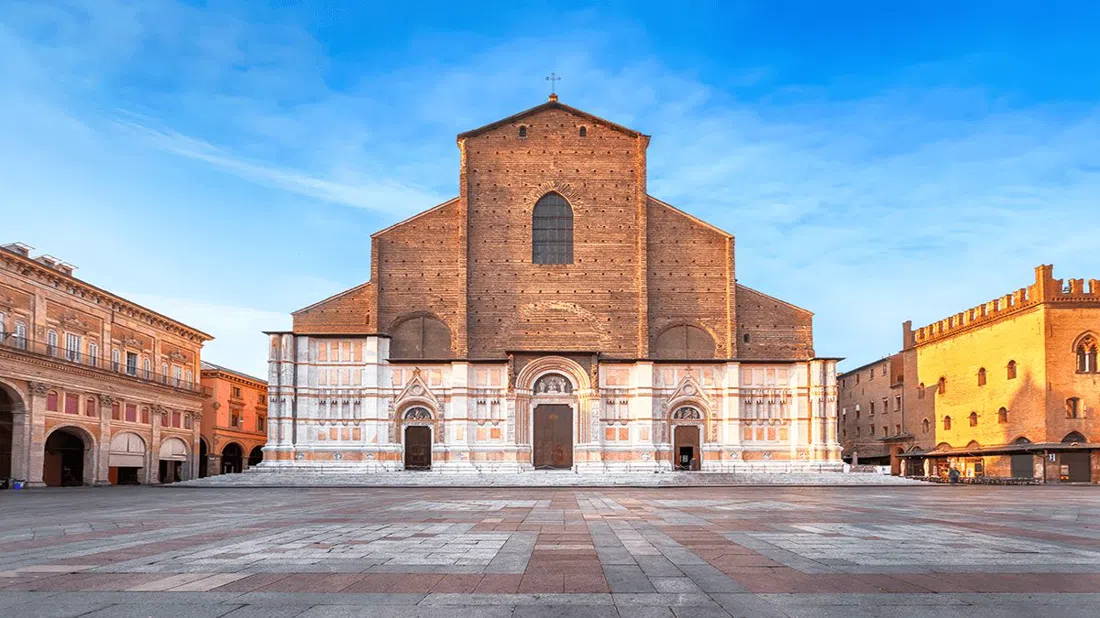
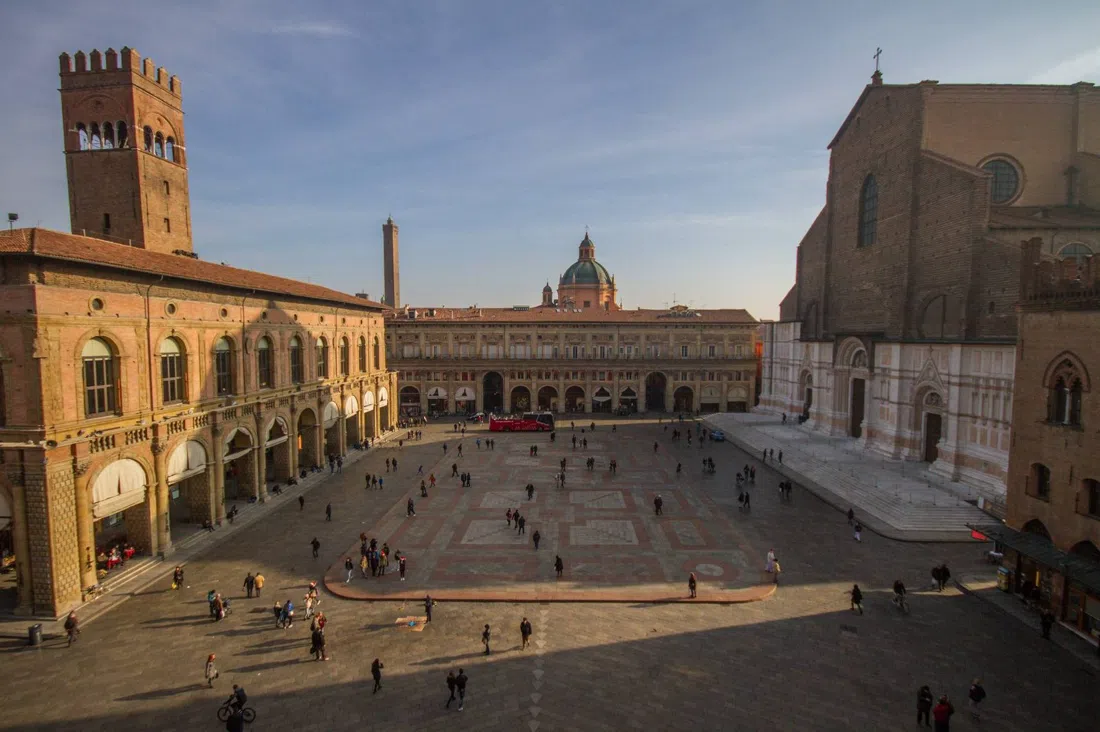
None of this makes sense without the ground the towers grew out of. The Basilica di San Petronio, filling the south side of Piazza Maggiore, is where to read the politics behind the height: this was meant to outdo St Peter's in Rome, a project so ambitious the church itself blocked its expansion, leaving the famous unfinished pink-and-white marble façade that still stops halfway up brick. Free entry, no booking required for fewer than fifteen people (larger groups book through the Sacristy), and worth the small €3 to €5 add-on to see the meridian line Cassini set into the floor in 1655, still one of the longest sundials in the world. The rooftop terrace that used to offer a tower-level view here has closed for good post-restoration. Treat San Petronio as the façade-and-piazza chapter of this story, not a viewpoint.
Immediately behind it, Palazzo Re Enzo and Palazzo del Podestà carry the actual power narrative: this was the seat of Bologna's medieval civic government, the institution that eventually tried, with limited success, to rein in the tower-building families whose private fortresses kept turning into open street warfare. It isn't a standard walk-in museum; access runs to scheduled public events and exhibitions, so check the calendar before sending anyone across the piazza expecting an open door. When it is open, entry is often free.
Two minutes east, the Quadrilatero is the market district the towers physically stood over, streets narrow enough that you can still feel the medieval plan underfoot rather than reading it off a map. It's open, walkable by any size of group, and worth doing at midday when the fish stalls and cheese counters are working rather than in the evening hush. Small-group food tour operators run tastings through here if you'd rather have someone else do the ordering. A minute further, Corte Isolani is the single best tactile counterpoint in the piece: a covered medieval passage with the best-preserved wooden portico left in the city, timber where everything else in this article is brick and stone. It's a free, open shopping passage, no restriction on numbers, and the kind of five-minute detour that makes the towers' verticality make sense by contrast.
The view the city was reaching for
Every tower in this piece was, at root, an argument about who could see furthest and be seen from furthest away. The argument's natural endpoint sits three and a half kilometres from the centre, on the hill above the city: the Santuario della Madonna di San Luca, reached by the Portico di San Luca, a covered arcade of 666 arches that is the longest portico in the world and, since 2021, a UNESCO World Heritage listing in its own right. Walking the whole covered climb takes the better part of an hour and involves real elevation; the San Luca Express trolley runs for anyone who'd rather arrive with breath to spare. Both the walk and the sanctuary are free, open-air, and take groups of any size without booking; the dome climb inside costs around €5 and is worth doing on a clear day.
What you get at the top is the view San Petronio's terrace used to offer and no longer does: the whole red-roofed sprawl of Bologna laid flat, Le Due Torri picked out on the skyline along with the handful of other surviving towers, the Apennine foothills behind you and the plain running north toward the Po. It's the only place left from which the medieval logic of the whole exercise (build high enough and the entire city becomes legible from your own front step) still actually works. Go in the last two hours before sunset if you can manage the timing; the light does the towers more favours than midday ever will.
Walking it with someone who knows the stones
For a first pass at all this with someone who can put names and feuds to the right buildings, Bologna Welcome's Discover Bologna walking tour covers the historic centre in small groups, with daily slots in Italian, English, French, German and Spanish, for roughly €15 to €20 per person. It won't get you up either of the closed towers (nothing will, for now), but it threads the Two Towers, San Petronio and the Quadrilatero into one guided route with the historical context that turns "look, old towers" into an actual understanding of why a medieval banking family thought a 97-metre brick spike was a reasonable investment. Book directly through Bologna Welcome's own desks rather than a third-party reseller; slots fill fastest on weekend mornings.
Getting there and budgeting for it
Bologna's historic centre is compact enough that everything in this piece sits within a 25-minute walk of Le Due Torri, and most of it inside ten. The airport connects to the centre by the Marconi Express monorail in about seven minutes; the main train station, Bologna Centrale, is a fifteen-minute walk or a short bus ride from the towers. Cash still gets used at market stalls in the Quadrilatero and for smaller tower-tour tickets, so carry some alongside a card. Budget a full day for the tower-and-museum route properly done: Le Due Torri's piazza, Torre Prendiparte or the Torre dell'Orologio, the Museo della Storia di Bologna, lunch in the Quadrilatero, San Petronio, and San Luca in the late afternoon light. Expect to spend somewhere between €40 and €70 per person on entries and tastings before dinner, more if a table at Casa Azzoguidi is part of the plan. Book Prendiparte and the Torre dell'Orologio ahead online; both run genuinely limited timed slots, and turning up without a booking on a Saturday is the most common way to end the day having climbed nothing at all. For where to stay while you're doing it, start with a Bologna hotel search; for the rest of the city beyond its towers, the full Bologna guide covers it.