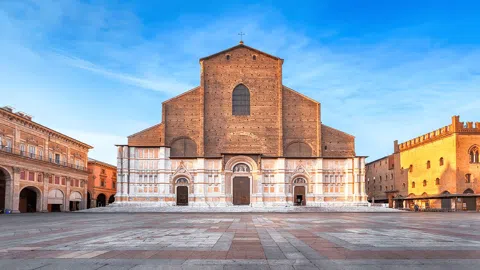
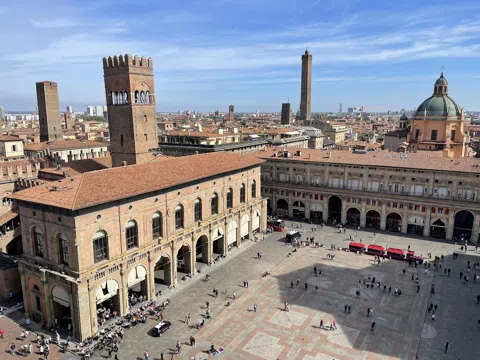
The Bologna issue
Life Under the Arches: Bologna's 40 Kilometres of Porticoes
A walking guide to the only city on earth built to be crossed dry — from the pilgrim's climb to San Luca to the working-class arches most visitors never reach.
By Beatrice HartleyBologna one neighbourhood at a time
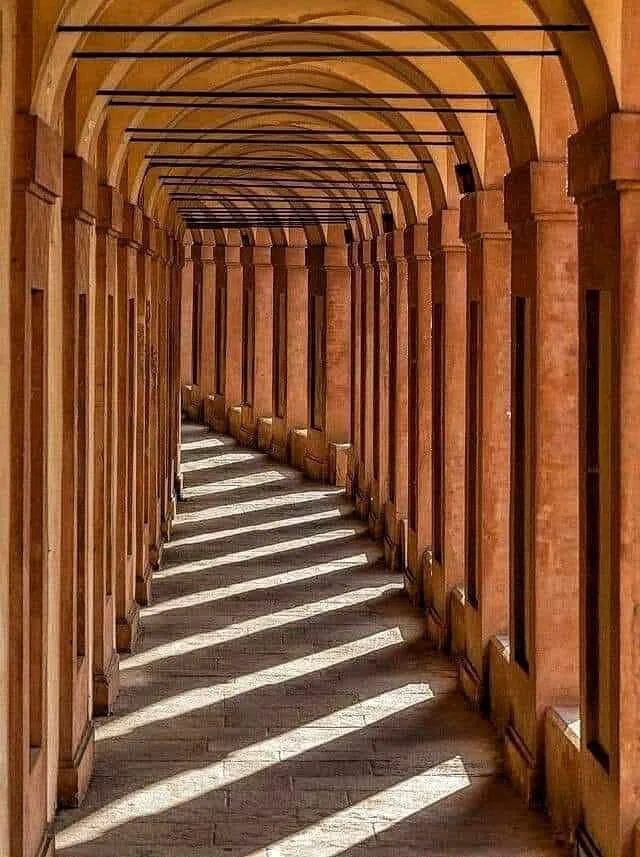
No other city has committed to a single idea quite so completely. Bologna has roughly 40 kilometres of covered walkway threaded through its streets — porticoes raised over eight centuries, from timber medieval overhangs to a 1960s housing estate — and in 2021 UNESCO inscribed twelve stretches of them as a single World Heritage site. What follows is not a checklist to be ticked off in an afternoon but a way of reading the city on foot, arch by arch, in the shade the Bolognesi built for themselves.
The pilgrim's climb: San Luca
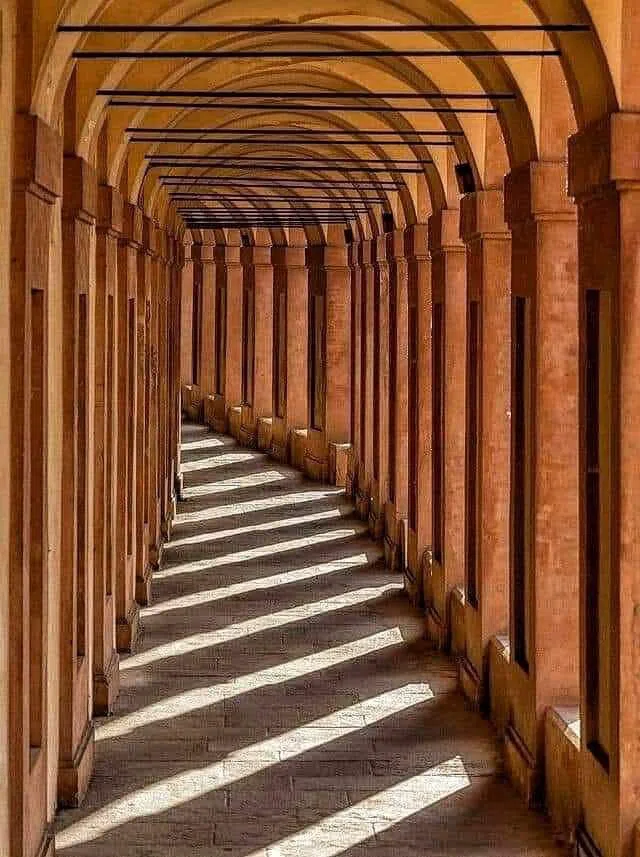
Start where the porticoes stop being ordinary. The Portico di San Luca (Colle della Guardia, on the city's southwestern hill) is the longest continuous covered walkway in the world — 3.8 kilometres and 666 arches climbing from the Saragozza gate to the sanctuary on the ridge. It has been free and open to anyone since it was finished in 1793, built by public subscription so that a Byzantine icon of the Madonna could be carried up to the basilica and back each spring without the rain touching it. That procession still happens. Walking it is UNESCO component 06 and the single most Bolognese thing you can do, but be honest with yourself and your companions about the gradient: the final stretch is genuinely steep, 45 to 60 minutes uphill, and it will find the limits of older knees. Guided walking groups and pilgrim parties set off daily, which is reassuring if you'd rather not go alone.
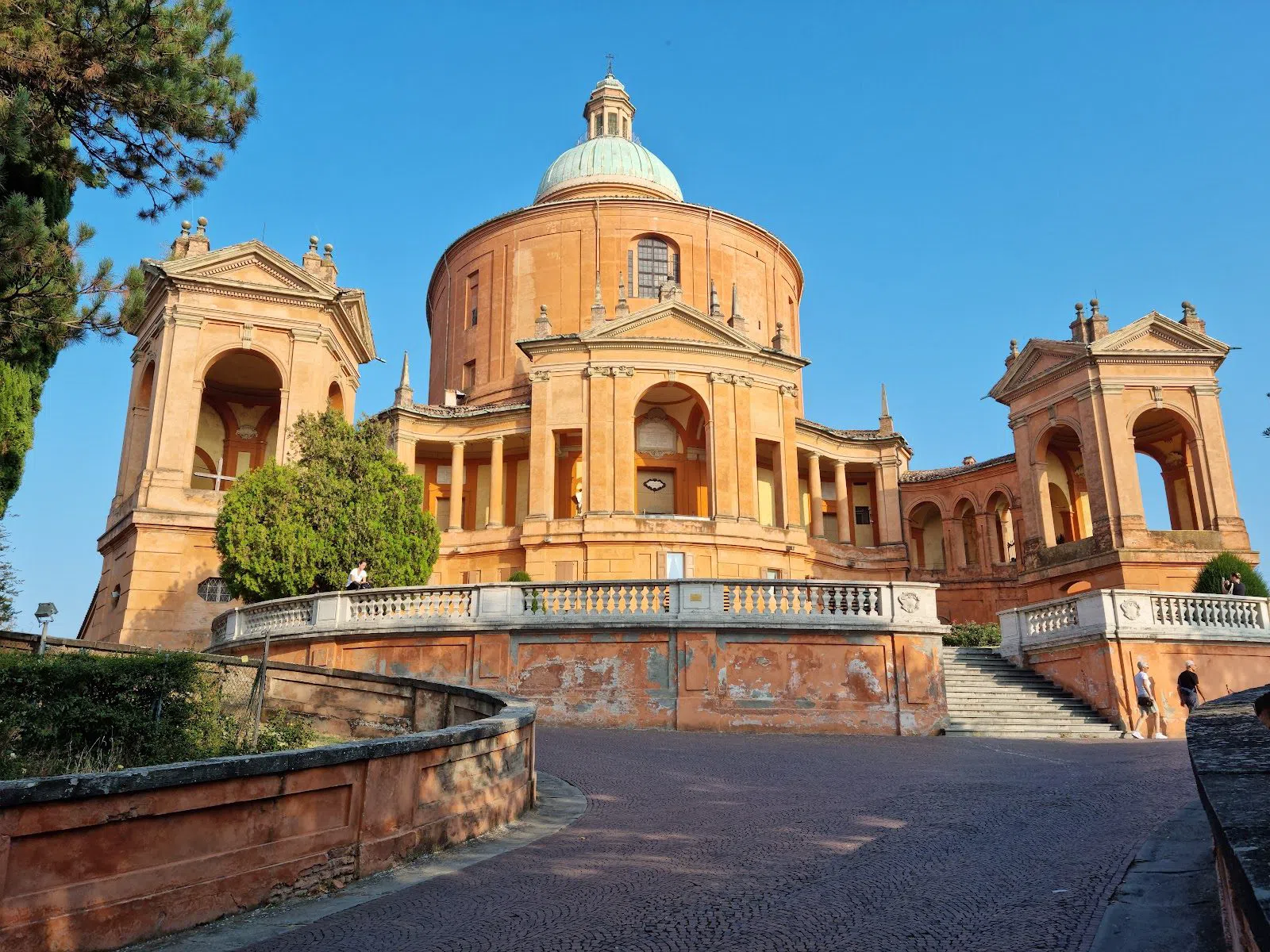
The reward at the top is a separate place worth naming in its own right. The Santuario della Madonna di San Luca (Colle della Guardia) is free to enter and used to groups arriving hot and breathless. The distinct pleasure here is the ticketed dome climb, the Salita alla Cupola — €5, a narrow staircase taken in small groups, and the rooftop view stitches the whole hill back down to the city and out across the Po plain. If you did the portico for the walk, do the dome for the payoff.
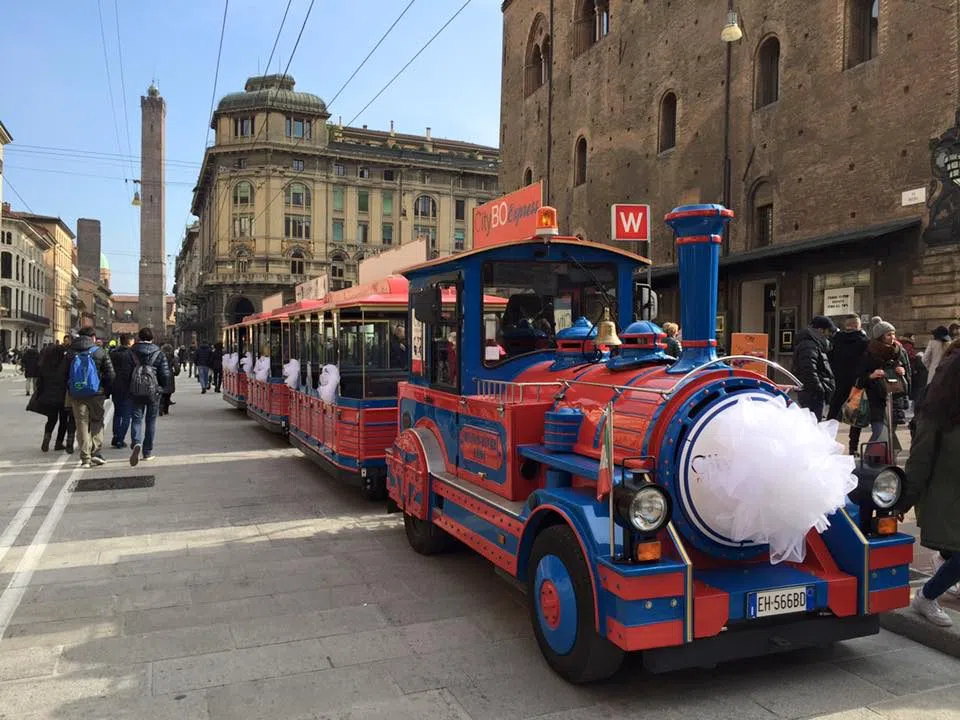
And if the climb simply isn't in the cards — travelling with children, with older relatives, or with a group that would rather save its legs for lunch — take the San Luca Express (departing Piazza Galvani, in the centre). It's a small tourist train, €10–15 round trip, built explicitly for groups with reduced and school fares, returning roughly every 45 minutes. There's no shame in it; it is the step-free, honest answer to the same question the pilgrims asked, and it gets you the view without the calf-burn.
Plan your Bologna trip
Live prices from our booking partners.
Free cancellation on many rooms. We may earn a commission when you book.
The city's living room: Piazza Maggiore and around
Back in the flat centre, the porticoes change register entirely — from devotional endurance to civic grandeur. The Portico dei Banchi (Piazza Maggiore) is the theatrical facade that closes the eastern side of the main square, a 16th-century screen designed by Vignola to hide a tangle of medieval shops and money-changers behind a single dignified rhythm of arches. It is part of UNESCO component 05, it is an open public square with no restrictions, and it is the natural place for any walking tour to gather — the meeting point, the orientation stop, the spot where a guide can point in four directions at once.
A few steps south runs the grandest shopping arcade in the old city. The Portico del Pavaglione (centro storico, flanking Piazza Galvani) is free and always open, but the reason to slow down here is tucked behind it: the Palazzo dell'Archiginnasio, the original seat of the university, whose Anatomical Theatre is one of the most extraordinary rooms in Italy. Carved entirely in spruce, ringed with wooden statues of famous physicians and presided over by two flayed figures holding up the lecturer's canopy, it is where medical students once watched public dissections by candlelight. Entry is modest — roughly €3–5 with an audio guide — and private or group tours are bookable Monday to Saturday. In peak season, book the theatre ahead; it is small and it fills.
Walk east from the square and the university announces itself. The Portici di Via Zamboni (University Quarter) are UNESCO component 07, the covered streets of the oldest university in the world, best approached from the foot of the leaning Two Towers and followed uphill past the palaces toward the Accademia. This is a lively, central, group-friendly stretch, at its best in term time when the arcades fill with students — noisier and more ordinary than the monuments, and all the better for it.
Squares, passages and the medieval city
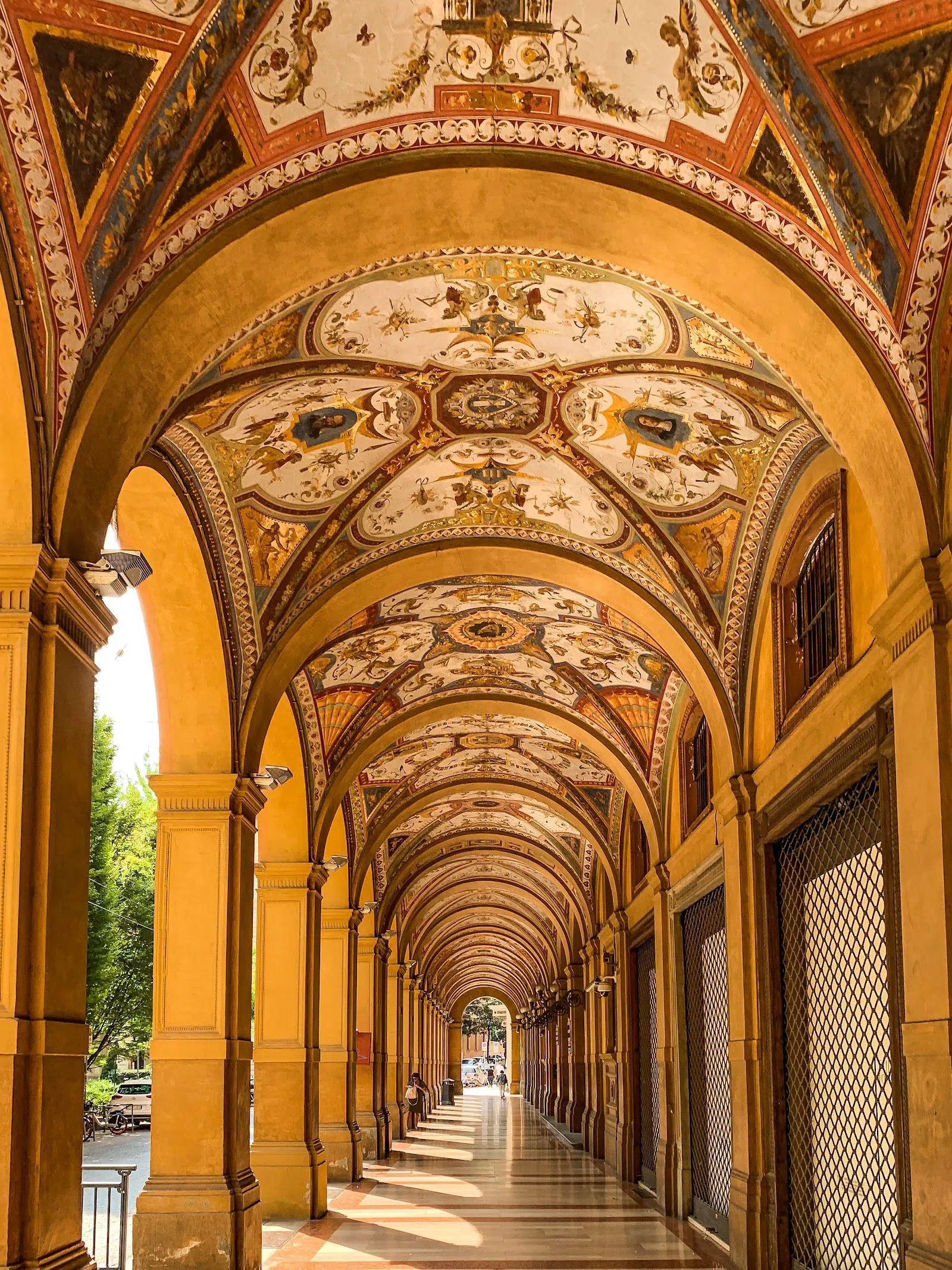
Bologna's most beautiful square is not the biggest. Piazza Santo Stefano (Santo Stefano district) is UNESCO component 02, a triangular open space that widens gently as it approaches the huddle of interlinked churches known as the Sette Chiese. The porticoes down each flank frame the scene like the wings of a stage, and the square is an unrestricted public space that doubles as a favourite gathering point for tour groups and, on weekends, a small market. It is the place to sit for ten minutes and simply watch the light move across brick.
Linking Santo Stefano back toward Strada Maggiore is one of the oldest survivals in the city. The covered Corte Isolani passage and Casa Isolani (Strada Maggiore / Santo Stefano) shelter a rare 13th-century timber portico — UNESCO component 10 — its slender oak posts rising nine metres, a fragment of how the whole medieval city once looked before stone and brick took over. The passage is public and lined with shops, perfectly fine for groups, and every guide will pause to point out the three wooden arrows lodged high in the ceiling. The legend attached to them is nonsense, delightfully so, and a guaranteed talking point.
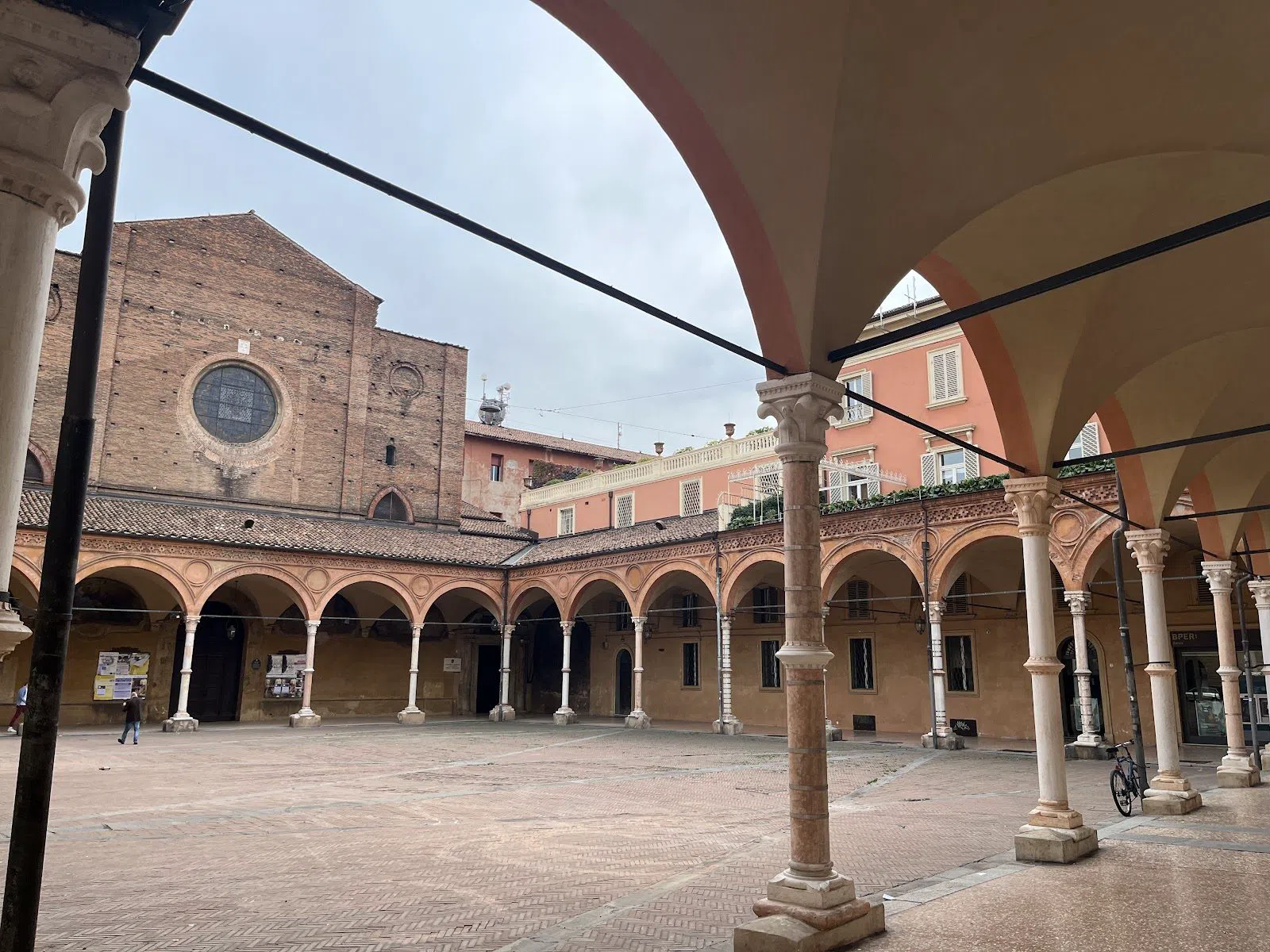
A short walk out along Strada Maggiore brings you to a quieter marvel. The Basilica di Santa Maria dei Servi (Strada Maggiore) has the only complete four-sided portico in the city — a serene quadriportico enclosing a courtyard, also part of UNESCO component 10. Entry is free and groups are welcome, though the open portico has some steps to mind. Inside hangs a Madonna attributed to Cimabue, and the whole stop sits pleasingly off the main tourist current: photogenic, calm, and rarely crowded.
Elegance and the genteel arcades
For a change of tone — and for anyone in your party more interested in shopfronts than shrines — the Galleria Cavour (near Via Farini, centro) is the city's most polished set of arcades, UNESCO component 09. The porticoes here are free and public; the gallery itself is a working upscale mall, so groups are fine during retail hours but this is browsing territory, not budget territory. It's the fashion-and-elegance face of the portico tradition, and a useful counterweight if the rest of your walking has been all incense and old wood.
Beyond the postcard: the quieter and the unexpected
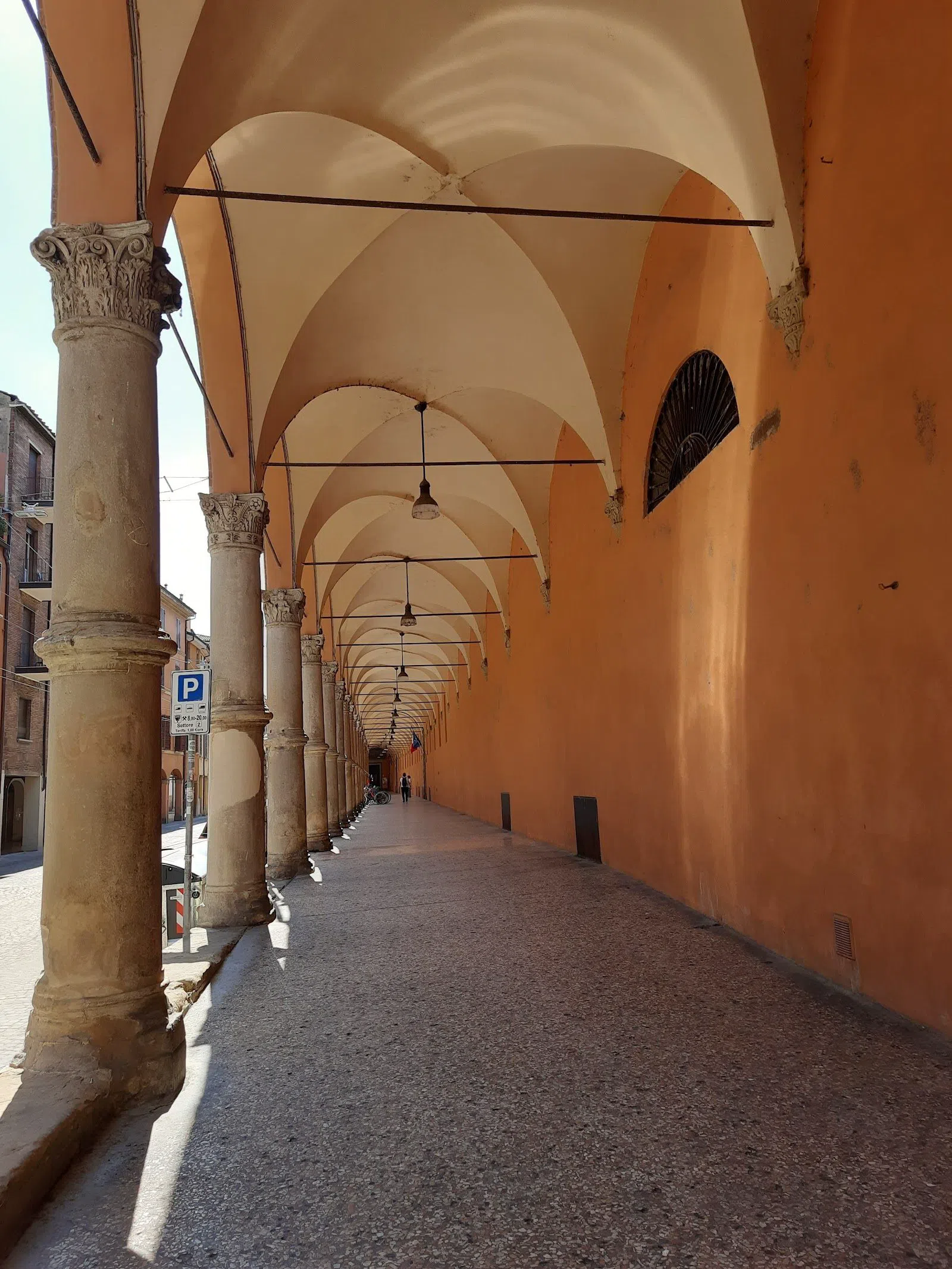
The further you get from Piazza Maggiore, the more the porticoes reward you. The Portico di Santa Caterina and Via Saragozza (Saragozza district) are UNESCO component 01, and they make the ideal contrast piece to the monumental arcades downtown: this is the city's tightest, most human-scaled covered walk, narrow enough in stretches to go single-file. That makes it a poor fit for a large coach party but a lovely one for a couple or a small group who want to feel how domestic these arches were meant to be.
On the eastern ring road, the Portico del Baraccano (Santo Stefano district) is UNESCO component 04, a quieter neighbourhood set-piece where a covered walk, an old city gate and a shrine fuse into one. There is nothing to book and nothing to queue for; it's simply an easy, open stop that works well as a breather on a longer portico route.
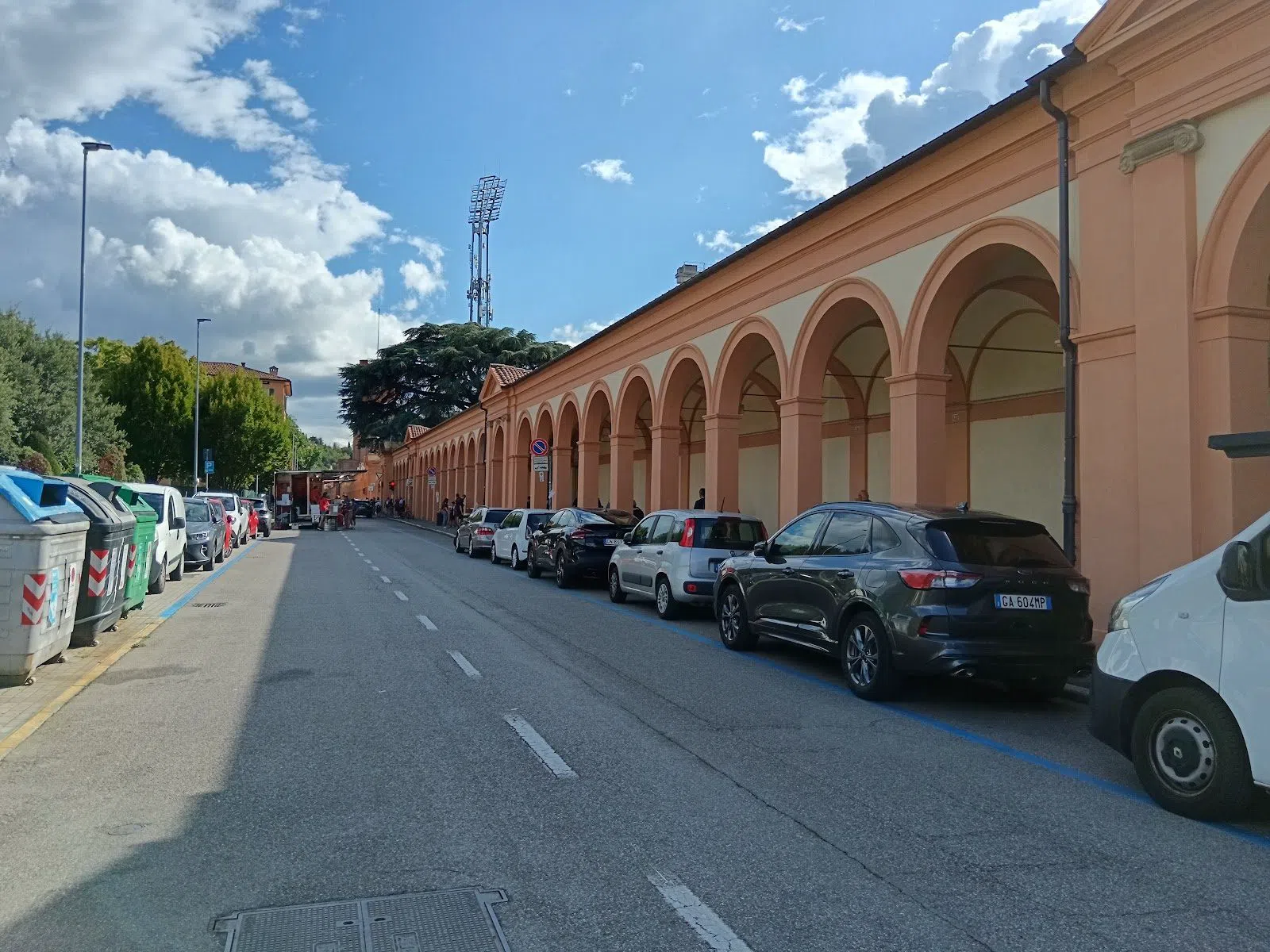
Two stops ask more of you, and repay it. The Portici della Certosa di Bologna (near the Stadio, western edge) are UNESCO component 08 — the frescoed walkways of a monumental cemetery that reads far more like an open-air gallery than anything morbid. Entry is free, the civic museums run guided group itineraries (the castrato Farinelli is buried here, and there are underground-Certosa tours), and in 2026 the site hosts European Cemeteries week. It is one of the great monumental cemeteries of Europe and almost nobody on a short trip thinks to go.
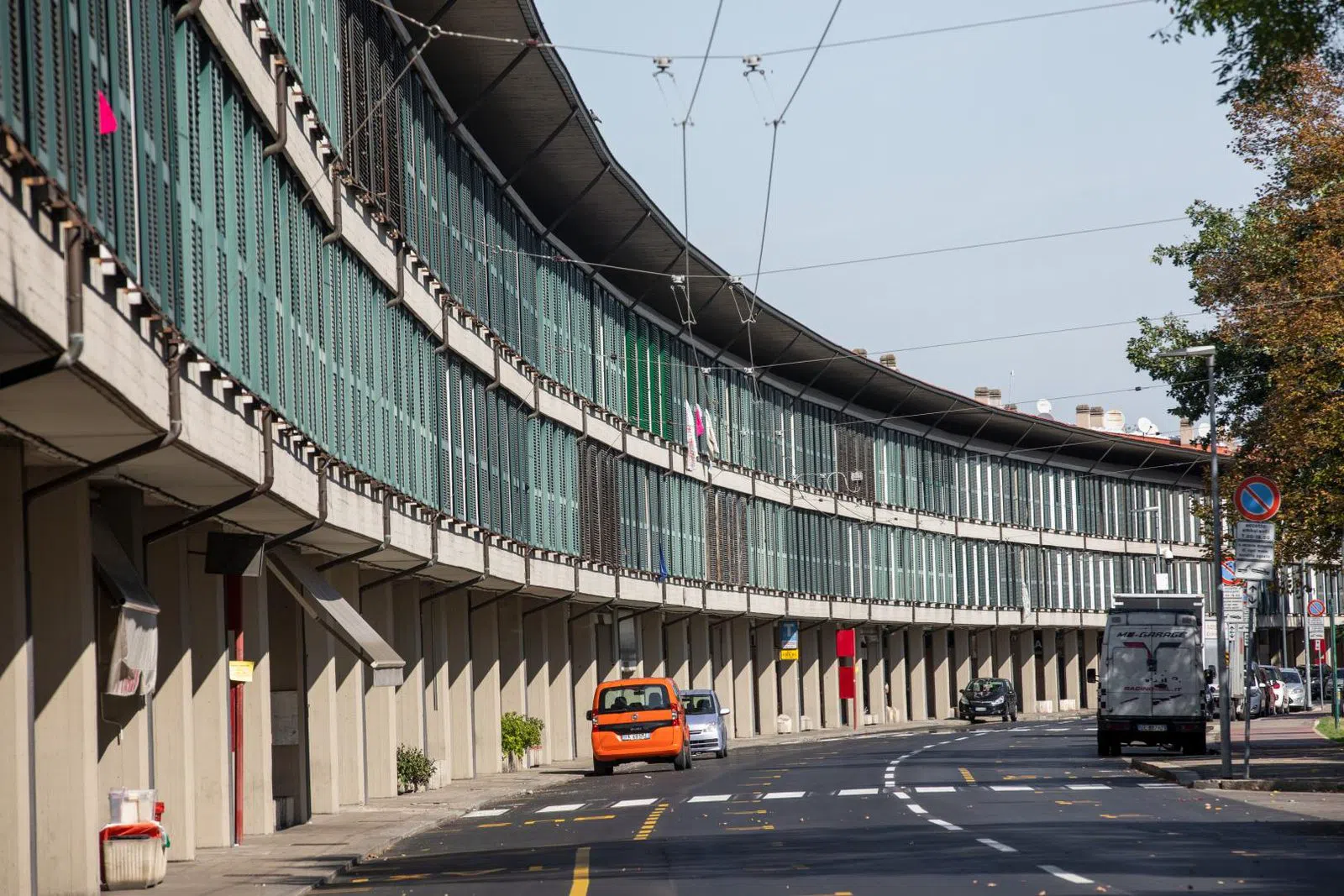
Finally, the wildcard. Il Treno della Barca (Barca district, western suburb) is the only modern portico on the UNESCO list — component 11 — a long, low, working-class arcade built in the 1950s under a residential block nicknamed "the train" for its shape. It is a public street-level walkway you can stroll freely, and it earns its place precisely because it isn't medieval: it's proof that the portico is a living civic habit, not a museum piece. This is genuine off-the-beaten-path territory, best suited to travellers with an appetite for architecture and social history rather than sightseeing box-ticking.
Practical notes for planning
Getting around. The twelve UNESCO stretches are scattered, but the historic core — Piazza Maggiore, the Pavaglione, Santo Stefano, Via Zamboni and Corte Isolani — is a compact and comfortably walkable cluster you can cross in twenty minutes, entirely under cover. San Luca, the Certosa and Il Treno della Barca sit out toward the western and southern edges; city buses reach all three, and the San Luca Express handles the hill for anyone skipping the climb.
Timing. The porticoes are, by design, the answer to bad weather — walk them in rain and you'll understand why they exist. Spring and early autumn are kindest for the San Luca ascent; high summer makes the uphill genuinely punishing. Book the Archiginnasio's Anatomical Theatre ahead in peak months, as it's small and popular.
Cash and prices. Almost everything here is free: every portico, both squares, all the churches. The paid extras are modest and worth it — the San Luca dome climb (€5), the Anatomical Theatre (about €3–5), and the San Luca Express (€10–15 round trip). Prices are in euro. Cards are widely accepted, but carry a little cash for the smaller ticket desks and any group tour tips.
Groups versus couples. The monumental porticoes — the Banchi, the Pavaglione, Santo Stefano — absorb large groups happily. The narrow Santa Caterina stretch and the intimate Corte Isolani suit couples and small parties far better. Older travellers should take the train up to San Luca without hesitation.
For somewhere to base yourself within walking reach of the arcades, browse the Bologna hotel search; for wider eating, timing and neighbourhood context, see the full Bologna guide. Bring comfortable shoes, look up as often as you look ahead, and let the arches do the navigating.
Before you go
How long is the walk up to San Luca, and is there an easier way?
The Portico di San Luca is 3.8 km with 666 arches, a steep 45–60 minute climb from the Saragozza gate. If the gradient isn't for you, the San Luca Express tourist train departs Piazza Galvani (€10–15 round trip, returning roughly every 45 minutes) and is the step-free alternative for families and older travellers.
How much does it cost to see Bologna's porticoes?
Nearly everything is free — every portico, both main squares and all the churches. The only paid extras are the San Luca dome climb (€5), the Archiginnasio's Anatomical Theatre (about €3–5) and the San Luca Express train (€10–15 round trip). Prices are in euro.
Which porticoes are best for a couple rather than a tour group?
The narrow Portico di Santa Caterina on Via Saragozza is single-file in stretches and far more intimate than the downtown arcades, and the timber Corte Isolani passage rewards a slow wander. Large groups fit better under the monumental Portico dei Banchi, the Pavaglione and around Piazza Santo Stefano.
Do I need to book anything in advance?
The porticoes themselves need no booking — they're free public walkways, always open. Reserve ahead only for the Anatomical Theatre behind the Palazzo dell'Archiginnasio (Monday–Saturday), which is small and fills in peak season, and for any group-guided itineraries at the Certosa cemetery.
What's the most unusual portico worth seeking out?
Il Treno della Barca in the western Barca district — the only modern portico on the UNESCO list, a 1950s working-class arcade under a residential block. It's genuinely off the tourist route and suits travellers curious about architecture and social history rather than headline sights.