The Bologna issue
Bologna's Leaning Towers and the Rivalry That Built Them
The tallest one is shut, the crooked one is in a steel corset, and the family feud behind both is still legible three streets in every direction. Here is how to read the towers in 2026.

By Beatrice HartleyBologna one neighbourhood at a time

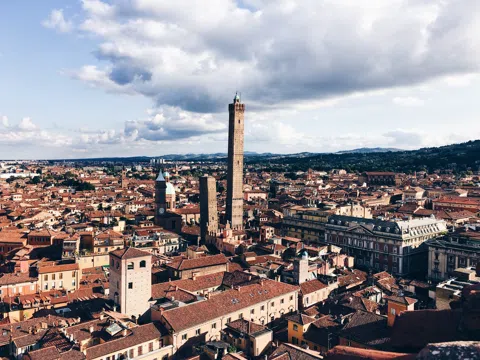
From the pavement of via Rizzoli the two brick shafts read less like a monument than an argument nobody won. One rises just under a hundred metres, dead upright, and has been closed to climbers since 2023; the other stops short, leans hard enough to make you step sideways for a better look, and stands inside a cage of steel cable while engineers work out how to keep it from going over. Bologna will tell you its noble families raced each other into the sky out of pride, and that is about half true. The half that isn't is the better story.
An argument in brick above via Rizzoli

Torre degli Asinelli (Piazza di Porta Ravegnana, at the eastern end of via Rizzoli) is the tallest surviving medieval tower in Italy, and for most of the last half-century it was also the thing you did in Bologna: 498 steps up a wooden staircase inside a brick chimney, then the whole red city laid out beneath you. That climb has been shut since 23 October 2023, so plan around the closure rather than around the hope. City officials have floated a restart before the 2028 works deadline; nothing firmer than that exists in 2026, and anyone promising you a ticket is selling something else. What remains is free and worth ten minutes of standing still: the tower is viewable from the street at any hour, in any weather, by any size of group, and the pavements of via Rizzoli and via San Vitale are wide enough to take a tour party without anybody stepping into traffic.

Torre Garisenda (the same piazza, immediately south-west of its neighbour) is the shorter, angrier-looking one, and it is the reason its taller companion is closed. It leans because it was already sinking within decades of construction (the subsoil beneath this corner of Bologna is a poor foundation for anything ambitious), and in 1353 the city lopped roughly thirteen metres off the top to reduce the load, which is why it now stands at a little under fifty metres. Dante name-checked that lean twice, an endorsement no marketing department could have bought, and it fixed the tower in the European imagination as the crooked one. A consolidation project worth about €20 million is now under way, using a ring of pylons and steel cables of the kind that saved Italy's more famous lean; it runs to at least 2028, and for its duration the piazza itself is fenced and closed to pedestrians. You cannot walk beneath the towers. You look at them from the street, from an angle, the way people did before ticketing existed.
Go early. The morning light comes down via Rizzoli and hits the brick side-on, the hoardings read as less of an intrusion, and the crowd that builds by eleven has not yet arrived. Then walk away from them, because the rivalry does not stop at this junction. It spreads three streets in every direction, and most of it is free.
Plan your Bologna trip
Live prices from our booking partners.
Free cancellation on many rooms. We may earn a commission when you book.
The rivalry's quiet winner stands three streets north
Torre degli Azzoguidi (via Altabella, a 150-metre walk north of the towers) is the second-tallest tower still standing in Bologna and the one that did the thing the others failed to do: it stayed straight. The street is named after its nickname, Altabella, tall and beautiful, which tells you what medieval Bologna thought of it. There is no way in; it is private property and always has been in the modern era, so treat it as a look-up rather than a visit. The lane is narrow enough that a group of a dozen will block the pavement, so make it a thirty-second stop on a walking route rather than a place to stand and lecture.

Torre degli Uguzzoni (in the tight lanes east of via Zamboni, inside what became the Jewish ghetto in 1555) is the best-preserved casa-torre in the city and, for my money, the most atmospheric corner in this whole story. The alleys here are barely two metres wide, which makes it a small-group proposition: four or six people, not a coach party. It matters to the rivalry for a reason nobody puts on a plaque. The Uguzzoni were one of the few Ghibelline clans in a Guelph city. These towers were not vanity projects in a peaceful town. They were the strongholds of families who expected, correctly, that the other side would one day come down the street with intent.


Torre Galluzzi and Corte Galluzzi (the courtyard between via d'Azeglio and Piazza Galvani, about 500 metres south-west of Porta Ravegnana) closes the argument. Built in 1257, it is the last of the great family towers, put up when the fashion was already ending, and it carries Bologna's own doomed-lovers legend: a Galluzzi daughter, a Carbonesi son, two families who could not be reconciled. Believe as much of that as you like. What is not legend is the doorway, set well above street level. These were keeps entered by a retractable ladder, and that single detail does more to explain the tower boom than any amount of talk about prestige. The courtyard is open, easy for groups, and has tables underneath for a coffee at ordinary courtyard prices.
Where the myth gets checked against the evidence
At some point somebody will tell you Bologna once had a hundred towers. It is a good line and it is a folk figure, not a count. Two museums will give you the real one.

Museo Civico Medievale (Palazzo Ghisilardi, on via Manzoni, five minutes west of the towers) is where the story stops being romantic and starts being documented. The tomb monuments of the medieval university professors and the armoury together explain what these families were actually competing over: jurisdiction, students, faction, money. A genuine tower survives in the museum's own courtyard, which is the closest most visitors will get to standing inside one. Admission is a low single-digit sum on the civic-museum tariff, free with the Card Cultura, and guided or school groups should book ahead on +39 051 2193916. It is closed on Mondays.
Palazzo Pepoli — Museo della Storia di Bologna (via Castiglione, 400 metres south of the towers) is the single best place to get the tower question answered properly, with maps and evidence rather than a number repeated down the centuries. It reopened on 30 November 2024 and is running normally through 2026, though its longer-term future is contested by a proposed conversion to a Morandi museum, so see it while it is this. Entry is €10 full with the audio guide included, €7 reduced for over-65s and groups, €5 for residents and students, free under 12; school groups go free. The atrium with its café and shop is free to enter, which makes it a workable meeting point for a group. Closed Tuesdays.


Palazzo Re Enzo and the Torre dell'Arengo (Piazza del Nettuno, adjoining Piazza Maggiore) supplies the counterweight the private towers never mention. This was the commune's own tower, and its bell, rung to summon the citizen militia, carried further in every sense than any nobleman's extra ten metres of brick. The building is now largely an event and congress venue, given over to private functions and fairs for much of the year, so it opens only for scheduled tours, exhibitions and events, typically €5 to €10 depending on what is on. Check dates before you build a day around it. The ground-floor voltone, the vaulted passage beneath, is free to walk through whenever the palace is open.
Getting above the city now that the big climb is shut

Torre dell'Orologio (Torre Accursi) at Palazzo d'Accursio (Piazza Maggiore, 350 metres west of Porta Ravegnana) is the practical answer. With the Asinelli ascent closed, this is the default way to get above Bologna, and it has an advantage the closed tower never had: from up here you see both leaning towers side-on, together, which is the only view that shows you what the rivalry actually looked like. Tickets are €10 full and €7 reduced for guided groups of six or more, over-65s and students, and it is free with the Bologna Welcome Card. Entries are timed every 20 minutes, so a large party will be split across slots. Build that into your morning. There is no lift, closed shoes are compulsory, there is a waiver to sign for the summit terrace, and under-8s are not allowed at the top.
Torre della Specola — Museo della Specola (Palazzo Poggi, via Zamboni, in the university quarter) is the one genuinely new thing here. The observatory tower reopened on 31 January 2026 with completely rebuilt displays, and it is visitable by guided reservation only, capped hard at 15 people at a time, so larger groups must be split across visits. Reserve at [email protected] or +39 051 2099610. The cost is museum admission, reduced at €3, plus €6 per person for the compulsory guided visit. It is 272 steps with no lift, and in rain the terrace is closed and you view the city from the glazed top-floor room instead, which is a good deal less thrilling. Ask about the forecast when you book.


Cupola del Santuario della Beata Vergine di San Luca (Colle della Guardia, above the south-west of the city) is the long view and the one that reframes everything. From the dome terrace the two towers stop being architecture and become a single crooked pin stuck into the middle of a red city, which is the perspective this story needs. Entry is €5, with proceeds going to the non-profit Succede Solo a Bologna. Getting there is either the celebrated portico walk, close to four kilometres of covered arcade climbing the hill, or the San Luca Express road train if legs or weather say otherwise; the dome itself is only about 110 steps once you arrive. Walk-ups are welcome, guided groups should book at [email protected], and last entry is 15 minutes before closing.
The one tower you can still get inside
Torre Prendiparte, known as la Coronata (via Sant'Alò, a short walk north of Porta Ravegnana near Altabella), is the strongest "climb a Bologna tower" story available in 2026. It reopened to guests in February 2026 after roughly six or seven years shut, it is the second-tallest surviving tower after Asinelli, and it is run hands-on by Matteo Giovanardi rather than by a management company. Be clear about what it is not: there is no walk-up, no ticket desk and no seat-by-seat booking. The whole tower is hired exclusively for overnight stays, private dinners, tastings, music evenings, sunset aperitivi and photo shoots, which puts it squarely in the special-occasion bracket for a couple or a small private group, at a premium price given on request. Enquire direct at [email protected], and enquire early; there is one of it.

What the towers actually stood among
Corte Isolani and Casa Isolani (the covered passage running between Strada Maggiore and via Santo Stefano, 300 metres from the towers) answers a question the skyline can't. The towers were never freestanding sculptures. They rose out of a dense fabric of timber-and-brick houses with enormous overhanging beams, almost all of which has since burned, collapsed or been rebuilt in stone. This passage preserves it. Look up for the three arrows lodged in the beams; several competing legends explain them, which is the point of a walk that sets myth against evidence. Present them to your companions as folklore, because that is what they are. The passage is free, self-guiding at any hour it is unlocked, and lined with shops and cafés.
Walking it with someone who has the current dates
Bologna's signature climb being shut is a real problem for a first-time visitor, and the honest fix is context rather than altitude. The Bologna Welcome — Discover Bologna city centre walking tour, run by the official tourist board, covers the towers from the street with the history attached, in scheduled multilingual departures or as a private group booking, at a mid-range per-person rate with free cancellation up to 24 hours before. Confirm the current itinerary when you book: routes have been re-cut around the closed Piazza di Porta Ravegnana, and what a guide can show you this month is not what it was three years ago.

A drink at the end of the walk
Terrazza Mattuiani at the Hotel Touring (via de' Mattuiani, south of Piazza Galvani) is the sensible closing beat, with conditions attached. Outdoor service is seasonal, roughly May to September, from 18:30 to 22:00 (19:00 in August), and it is weather-dependent, so reservations are compulsory even for hotel guests. There is a mandatory first drink from €15 per person. Tables are bookable up to ten days ahead; parties of eight or more pay a 50% deposit; a full buyout seats 30 or holds 50 standing from a €3,000 minimum spend. Come for the rooftop read of the red rooftops rather than for a guaranteed photograph of the two towers, and check the sightline yourself before you promise anyone that shot.

Practicalities
Everything above except San Luca sits inside a 1.5-kilometre circle, and the porticoes mean you can walk the whole route in rain without an umbrella; leave the taxi money for the hill. San Luca is reached by city bus and the San Luca Express road train, or on foot up the portico if you have the morning and the knees. From the airport, the Marconi Express people-mover runs into Bologna Centrale in a few minutes, and the station is a 15-minute walk from Piazza Maggiore. Cards are accepted almost everywhere, but keep €10 to €20 in coins and small notes for the San Luca dome, civic-museum tariffs and a courtyard coffee.
Time it around the closed days: Museo Civico Medievale shuts on Mondays and Palazzo Pepoli on Tuesdays, so a Monday-and-Tuesday city break needs the museums split across both. Book the Specola visit and the Torre dell'Orologio slot before you arrive, since both run on capped timed entries. As a budget, a full day of tower-hunting (the clock tower, one museum, the San Luca dome and a decent lunch) lands around €40 to €50 per person, and almost everything at street level costs nothing at all. For where to sleep within walking distance of Porta Ravegnana, start with a Bologna hotel search; for the rest of the city beyond the towers, the Bologna guide covers the food, the porticoes and the university quarter in more detail.
One last thing. Nobody knows exactly how many of these towers Bologna once had, and the round hundred you will hear quoted is a story about the city rather than a census of it. Two of them still lean over via Rizzoli, arguing. That is enough.
Before you go
Can you climb the Torre degli Asinelli in 2026?
No. The 498-step ascent has been closed since 23 October 2023 while workers stabilise the neighbouring Garisenda, and no reopening date is confirmed. City officials have talked about a restart before the 2028 works deadline, but nothing firmer has been set. You can still see the tower for free from via Rizzoli and via San Vitale; the piazza beneath both towers is fenced off to pedestrians.
Which Bologna tower can you actually climb instead?
The Torre dell'Orologio at Palazzo d'Accursio on Piazza Maggiore is the obvious one: €10 full, €7 for groups of six or more, over-65s and students, free with the Bologna Welcome Card, timed entries every 20 minutes, no lift. The Torre della Specola at Palazzo Poggi reopened on 31 January 2026 and takes 15 people at most per guided visit, by reservation. The San Luca dome, €5, gives the widest view of all.
Why does the Torre Garisenda lean, and can you walk underneath it?
It began sinking into weak subsoil within decades of being built, and in 1353 the city took roughly 13 metres off the top to reduce the load. Dante mentioned its lean twice. You cannot walk beneath it: a €20 million consolidation using pylons and steel cables runs to at least 2028, and Piazza di Porta Ravegnana is closed to pedestrians for the duration, so you look at it from the street.
Did Bologna really have a hundred towers?
That figure is folklore, not a count. For the researched answer, with maps and documentary evidence, go to Palazzo Pepoli, the Museo della Storia di Bologna on via Castiglione: €10 full, €7 reduced, closed Tuesdays. The Museo Civico Medievale fills in what the tower-building families were competing over.
Can you stay overnight in a medieval tower in Bologna?
Yes, in one. Torre Prendiparte, la Coronata, reopened to guests in February 2026 after around six or seven years closed, and it is the second-tallest surviving tower in the city. You hire the whole tower rather than a room or a seat, for stays, private dinners, tastings and sunset aperitivi, at a premium price on request. Enquire direct at [email protected], well in advance.